
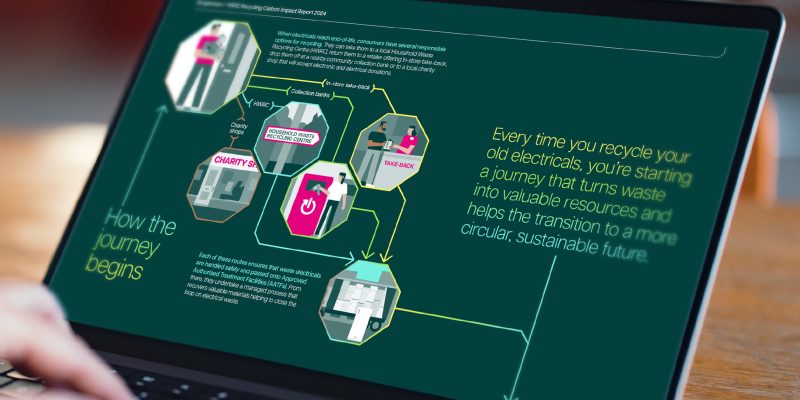
Ecogenesys, the UK’s leading not-for-profit, member-owned producer compliance scheme for electrical and electronic equipment (EEE), has released its first Carbon Impact Report, providing electrical producers with verified insight into the net carbon savings achieved through their share of electrical recycling activities.
Carbon Impact Report: Sharing and celebrating our members’ environmental impact – Ecogenesys
Peer-reviewed to ISO 14044 standards
Each member report details the organisation’s proportional contribution to Ecogenesys’ nationwide recycling activities during 2024, calculated using the Ecogenesys Carbon Model, which has been peer-reviewed to ISO 14044 standards, the international benchmark for environmental Life Cycle Assessment (LCA). This milestone is a step forward in helping electrical producers to understand, communicate and celebrate their contribution in reducing carbon emissions through responsible end-of-life recycling of electrical and electronic equipment.
Celebrating milestone contributions
Abs Bokhari, Executive Chairman of Ecogenesys, said: “The launch of the first Ecogenesys Carbon Impact Report marks an important milestone for our producer members. For the first time, our members have access to clear, quantifiable insights into the environmental impact of the end-of-life electrical recycling that they fund.
“Our ISO 14044 peer-reviewed carbon model provides members with reliable, measurable data. This report enables our members to quantify and communicate the sustainability benefit of electrical recycling.
It’s a proud moment for Ecogenesys and our members, demonstrating how our commitment to responsible recycling delivers real, measurable progress towards a lower-carbon future.”
Carbon modelling
The Ecogenesys Carbon Model provides a method for calculating net carbon savings across the electrical recycling process. Developed with support from Small World Consulting, the model uses data from transport operators, treatment facilities and recognised lifecycle databases to measure emissions generated during collection, treatment and processing. It also quantifies the emissions avoided through the recovery and reuse of secondary raw materials, including metals, plastics and components that replace virgin production.
The outcome is a verified net carbon saving that accurately reflects the environmental benefit of responsible recycling. Developed in line with ISO 14044 life cycle assessment standards and independently peer-reviewed, the model ensures every figure is reliable and validated.
Why this report makes a difference
The Ecogenesys Carbon Impact Report importantly demonstrates that the environmental impact of recycling waste electricals – overall, has a positive environmental and sustainability benefit.
The carbon impact report matters because it quantifies these benefits, showing how responsible recycling directly supports carbon reduction and resource efficiency.
When end-of-life electricals are recovered and processed, valuable metals, plastics and components are made available to manufacturers. This recovery of secondary raw materials reduces the reliance on virgin materials and associated emissions, helping to close the loop on resource use and making every tonne recycled a part of a sustainable circular economy.
The result is a measurable net carbon saving that captures the real environmental value of responsible recycling and helps close the loop towards a more sustainable, circular economy.
Each Ecogenesys member has received a full report, which also features an illustrative breakdown of recycling and recovery processes for each electrical waste stream. These illustrations provide each electrical producer with a practical communications and engagement tool that enables them to understand, showcase and support their evidence-based sustainability storytelling.
About Ecogenesys
Ecogenesys is the UK’s leading producer-led compliance scheme for electrical and electronic equipment (EEE), where fair costs, trusted expertise and a commitment to sustainability puts members in control. Formerly known as REPIC, the organisation rebranded in March 2024 to reflect its expanded mission – supporting members with a broader range of services designed to help them navigate an evolving landscape of regulation and sustainability. Established in January 2004 by leading companies in the electrical and electronics industry, this not-for-profit compliance scheme helps producers meet responsibilities under environmental legislation covering WEEE, Batteries and Packaging.